
2026 State of Validation Study Reveals Significant Headroom Remains for Further Digitization
LIMERICK,
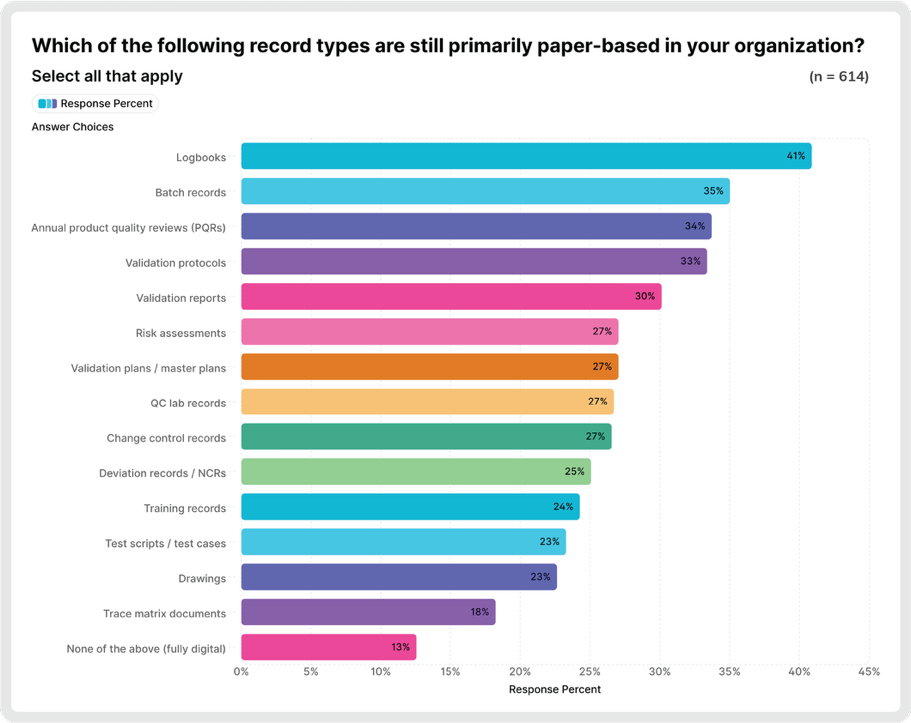
Despite the progress the industry has made digitizing its validation data, with nearly two-thirds either fully using or actively implementing a dedicated digital validation tool, the report shows that full digital maturity is still limited. With only 13 percent of respondents saying their organization is fully digital across all record types, there remains considerable ground to cover.
Paper Still Dominates Across Core GxP Records in 2026
Other findings in the 2026 State of Validation study indicate that:
- validation workload pressure is rising: 80 percent of respondents say their organization’s validation workload increased over the past year, with 45 percent describing that increase as significant. This steep ramp in requirements reinforces the need for scalable and more efficient operating models, especially considering that paper remains persistent in critical documentation. Forty-one percent of respondents say logbooks are still primarily paper-based, 35 percent say the same of batch records, and 33 percent cite validation protocols.
- digital investment is generating measurable operational value: among respondents with implemented or in-progress systems, 74 percent say ROI has met or exceeded their initial predictions. Within that group, 53 percent say ROI has exceeded initial predictions, including 30 percent who say it has significantly exceeded expectations.
- AI is being adopted in GxP environments, with governed, human-reviewed use cases favoured over fully autonomous ones: 78 percent of respondents are confident that AI will become a standard part of validation by 2030, and nearly 40 percent of organizations are either using or actively evaluating AI in a GxP validation or quality setting right now. The most widely accepted use case is AI used for drafting or summarization with mandatory human review, selected by 53 percent of respondents. AI and automation ranks last as a driver of future improvement. This does not indicate that AI is considered unimportant - the preceding sections demonstrate strong and growing AI engagement. Rather, it reflects the sequential logic of practitioners: digital transformation and data integrity must come first; AI and automation build on that foundation. Acceptance declines as autonomy increases: 38 percent consider AI decision support with human approval acceptable, 37 percent accept deterministic rules-based automation, 29 percent accept AI that executes workflow actions automatically with an audit trail, and 16 percent accept AI making or changing GxP decisions autonomously without human approval.
- digital maturity is emerging as a prerequisite for responsible AI deployment in regulated environments: digital transformation is viewed as the most transformative development for improving validation, while AI ranked last. This prioritization signals that AI and automation must build on a solid, trusted digital foundation, and it is. Among organizations that have fully implemented a digital validation tool, 64 percent are currently using or piloting AI in validation or quality activities, compared with 13 percent of those with no plans to adopt a digital validation tool.
“We thank every respondent who contributed their time and expertise to the 2026 study. These findings, drawn from professionals across six continents and more than 30 industries, paint a picture of a profession under pressure - but responding with growing sophistication, strategic investment, and a clear eye on what comes next,” said
About Kneat
For further information:
Investor Relations Lead
+1 902-706-9074
katie.keita@kneat.com
A photo accompanying this announcement is available at https://www.globenewswire.com/NewsRoom/AttachmentNg/417c5c38-e7b8-49ff-8b7c-0c4691bd46a0


Paper Still Dominates Across Core GxP Records in 2026
Logbooks, batch records, and validation protocols are the most frequently cited record types where paper persists.
Source: kneat.com